
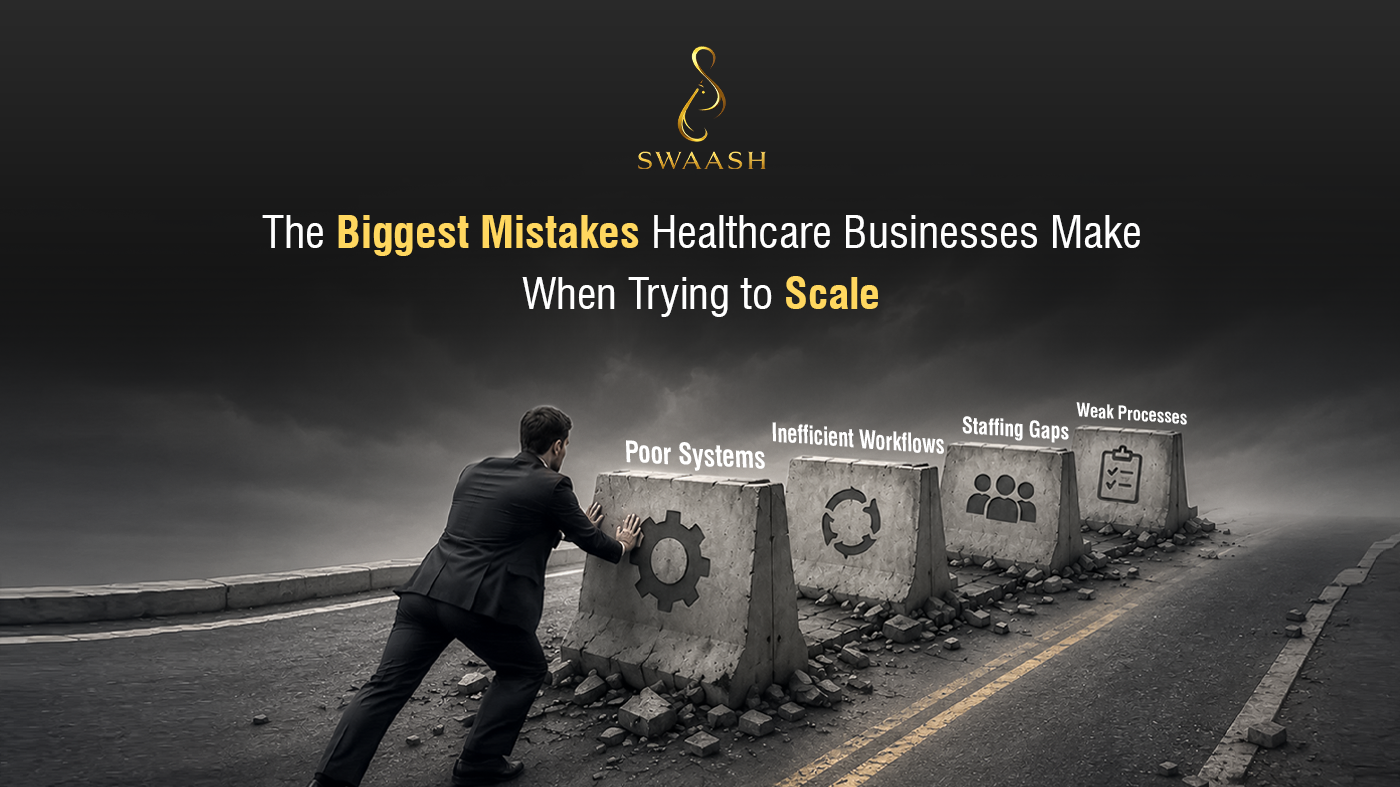
“Once we grow a little more, things will become easier.”
It is something a lot of healthcare business owners believe.
Then growth actually happens.
More patients start coming in.
The team gets bigger.
Marketing begins working.
And somehow…everything feels more difficult than before.
Appointments are harder to manage.
Communication becomes inconsistent.
The owner is involved in every decision.
The business looks successful from the outside, but internally, everyone is just trying to keep up.
If you’ve ever felt that way, you’re definitely not the only one.
The truth is, scaling a healthcare business is very different from running one.
Growth brings opportunities, but it also exposes every weak process you’ve been able to work around until now.
Growth Does Not Fix Problems. It Reveals Them.
In the early days, you can manage a lot with effort.
You remember to call patients back.
You know exactly what every employee is working on.
If something goes wrong, you fix it yourself.
It works.
Until it doesn’t.
Once the business starts growing, the same approach quickly becomes exhausting.
What felt manageable with a small team starts creating delays, confusion, and unnecessary pressure.
That is why healthcare scalability is about much more than adding more patients or opening another location.
It is about building a business that can actually handle growth.
Mistake #1: Thinking More Patients Automatically Mean More Growth
This is probably the biggest misconception.
More patients increase revenue.
But they also increase workload.
Without stronger systems, growth usually creates:
- longer response times
- scheduling issues
- overwhelmed staff
- inconsistent patient experiences
And honestly, none of that feels like success.
The goal is not simply getting busier.
The goal is becoming more efficient as you grow.
Mistake #2: Waiting Too Long To Improve Operations
Many healthcare businesses only think about operations after problems become obvious.
That is usually too late.
Processes that worked for ten employees rarely work the same way for thirty.
The same goes for patient volume.
Growth changes everything.
Which is why operational improvements should happen before they become urgent.
This is where many organizations benefit from healthcare marketing and operations support, making sure growth and operations improve together instead of separately.
According To Harvard Business Review
According to the Harvard Business Review, organizations that align strategy, people, and operations are significantly more likely to sustain long-term growth than businesses that optimize departments independently.
Healthcare businesses are no different.
When teams, marketing, and operations move in the same direction, growth becomes much easier to manage.
Mistake #3: Depending Too Much On One Person
Every growing business has that one person everyone depends on.
Sometimes it is the founder.
Sometimes it is the clinic manager.
Sometimes it is one experienced employee who knows everything.
At first, it feels reassuring.
Eventually, it becomes risky.
Because businesses cannot scale if every important decision depends on one individual.
Strong systems reduce dependency.
That creates consistency.
What Scaling Looks Like With And Without Systems
| Growing Without Structure | Growing With Structure |
| Constant firefighting | Clear workflows |
| Reactive hiring | Planned growth |
| Owner involved in everything | Shared accountability |
| Inconsistent patient experience | Standardized processes |
| Growth feels stressful | Growth feels manageable |
Simple takeaway:
The businesses that scale well usually become more organized, not simply bigger.
Mistake #4: Treating Marketing And Operations Like Separate Teams
This happens surprisingly often.
Marketing generates inquiries.
Operations struggle to keep up.
Patients wait longer.
The experience suffers.
Then everyone wonders why growth slowed down.
Marketing and operations should support each other.
Strong healthcare marketing and operations support means the promises made through marketing are backed by systems that consistently deliver.
That creates trust.
And trust creates long-term growth.
Mistake #5: Trying To Solve Everything By Hiring More People
Hiring matters.
But hiring without improving workflows often creates new challenges.
More communication.
More coordination.
More opportunities for mistakes.
Sometimes the issue is not a lack of people.
It is a lack of clarity.
The most efficient healthcare businesses are not always the ones with the largest teams.
Usually, they simply have better systems.
Mistake #6: Making Decisions Without Looking At The Numbers
Many businesses rely heavily on instinct.
Experience matters.
But data matters too.
Questions like:
- Which services perform best?
- Where are patients dropping off?
- Why are cancellations increasing?
- Which marketing efforts actually generate loyal patients?
These answers should come from information, not assumptions.
This is one reason healthcare business growth consulting often starts with understanding existing operations before recommending new strategies.
The Businesses That Scale Best Usually Feel Calmer
This surprises many people.
You would expect bigger healthcare businesses to feel more stressful.
The opposite is often true.
Well-run organizations usually have:
- clearer workflows
- better communication
- documented processes
- stronger accountability
People know what to do.
Patients know what to expect.
Problems still happen.
They just do not become emergencies every day.
Scaling Should Feel Intentional
Growth is exciting.
But sustainable growth rarely happens by accident.
It comes from making small operational improvements long before they become urgent.
It comes from building systems instead of depending on memory.
It comes from improving communication instead of simply increasing workload.
That is what healthcare scalability really looks like.
Not just getting bigger.
Getting stronger.
If your organization is exploring healthcare business growth consulting, strengthening healthcare marketing and operations support, or preparing for long-term healthcare scalability, it helps to identify the operational gaps that become more expensive as your business grows.
Schedule a call with our experts at SWAASH to build stronger systems, improve operational efficiency, and create a healthcare business that is ready for sustainable growth.
FAQs
Our clinic is growing, so why does everything suddenly feel harder?
That usually means your systems have not grown at the same pace as your business. Growth often exposes operational gaps that were easy to manage before.
When should a healthcare business start preparing to scale?
Earlier than most owners think. Building structure before rapid growth makes expansion much smoother later.
Can better operations really improve growth?
Absolutely. Better workflows reduce delays, improve patient experience, and help teams manage higher demand more efficiently.
Why is healthcare marketing and operations support important?
Because marketing brings opportunities, but operations determine whether your business can consistently deliver on those promises.
How does healthcare business growth consulting help?
It helps identify bottlenecks, improve workflows, and build systems that support long-term, sustainable growth rather than short-term expansion.