
A few years ago, most healthcare businesses were asking:
“How do we get more patients?”
Now, the question sounds different.
“How do we grow without making everything harder?”
Because let’s be honest.
Growth sounds exciting until you are buried under appointments, follow-ups, staffing issues, and endless admin work.
The phones are busy.
The team is busy.
Everyone is working.
Yet somehow, it still feels like the business is constantly playing catch-up.
This is exactly why the future of healthcare looks very different from the past.
Not because humans are disappearing.
But because smart businesses are learning how to combine people, technology, and systems in ways that make growth feel manageable.
And honestly, the businesses doing this now are quietly pulling ahead.
Healthcare Is Becoming More Complex
Patients expect more today.
Faster communication.
Online scheduling.
Quicker answers.
Seamless experiences.
Meanwhile, clinics and healthcare businesses are dealing with:
- rising administrative work
- staffing shortages
- higher patient expectations
- operational inefficiencies
Trying to solve everything by hiring more people only works for so long.
Eventually, complexity catches up.
That is why healthcare automation is becoming less of a luxury and more of a necessity.
Nobody Opens A Clinic To Spend Half The Day On Admin Work
Think about where time actually goes.
Appointment reminders.
Scheduling changes.
Following up with patients.
Managing records.
Sending messages.
Updating systems.
None of these tasks are difficult.
But they are repetitive.
And repetition is expensive.
Not because the work is impossible.
Because it steals attention from things that matter more.
This is where healthcare workflow automation starts making sense.
Not to replace people.
To remove unnecessary work.
According To The World Economic Forum
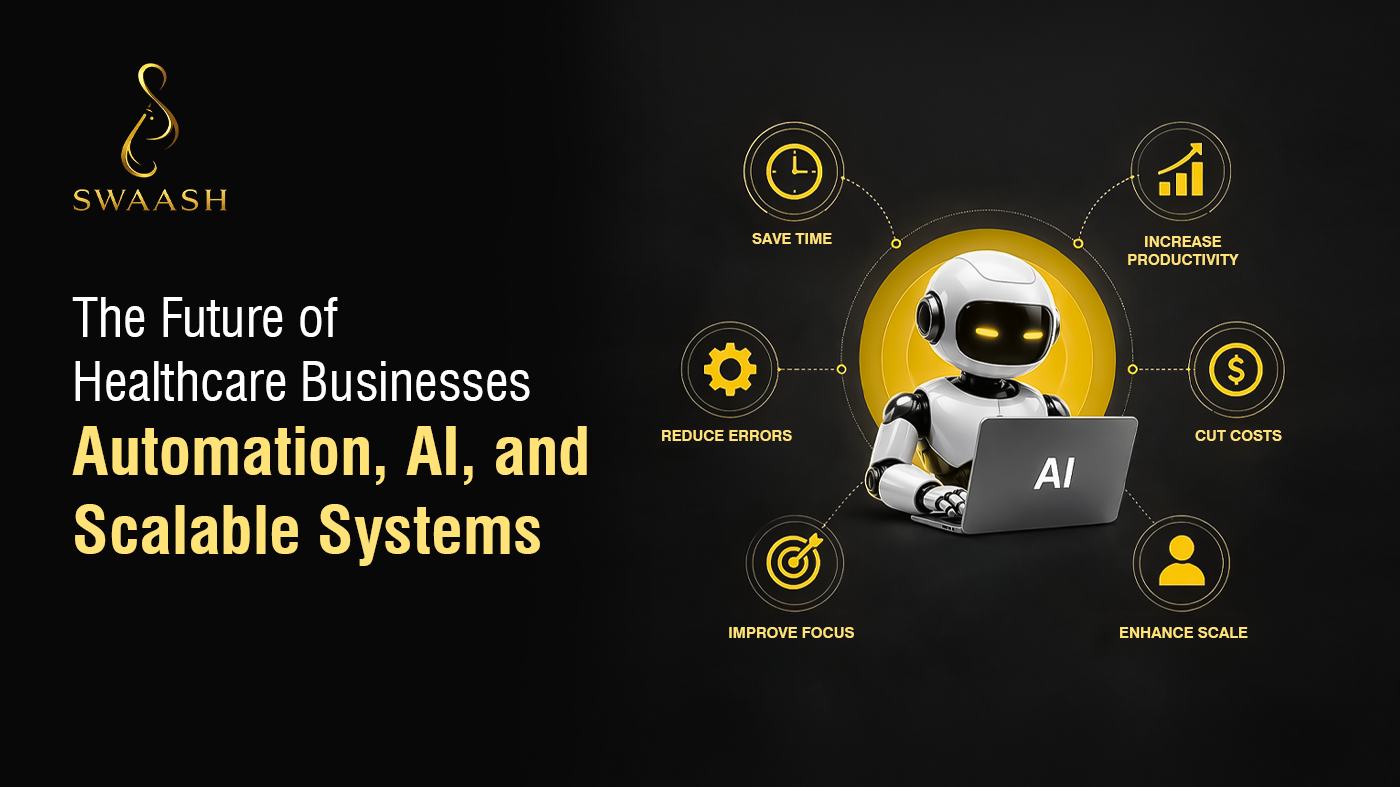
According to the World Economic Forum, AI and intelligent technologies are expected to transform industries by improving productivity and allowing teams to focus more on higher-value work.
Healthcare is already seeing that shift.
The conversation is slowly moving away from “Can we use AI?” to “Where can AI help us work better?”
AI Is Quietly Changing Daily Operations
People hear AI and immediately imagine robots replacing doctors.
That is not reality.
Most applications of AI in healthcare business operations are much simpler.
Things like:
- smarter scheduling
- automated follow-ups
- faster documentation
- predictive reporting
- answering routine questions
Nothing dramatic.
Just less repetitive work.
And honestly, those small improvements add up quickly.
The Clinics That Feel Less Chaotic Usually Have Better Systems
Have you ever walked into two equally busy clinics and wondered why one feels calm while the other feels overwhelmed?
The answer is rarely luck.
Behind the scenes, organized businesses usually have:
- standardized processes
- automated workflows
- clear communication
- better visibility
The patient may never see those systems.
But they definitely experience the results.
What Growth Looks Like With And Without Systems
| Reactive Operations | Scalable Operations |
| Manual reminders | Automated workflows |
| Constant interruptions | Structured processes |
| Staff overwhelmed | Better workload management |
| Growth creates stress | Growth feels manageable |
| Owner involved in everything | Clear accountability |
Simple takeaway:
Growth becomes easier when systems carry the weight instead of people.
Outsourcing Is Becoming Part Of The Growth Strategy
Many healthcare businesses used to think outsourcing meant giving up control.
That perception is changing.
Today, healthcare operations outsourcing helps businesses handle:
- administrative support
- scheduling
- patient communication
- backend operations
- workflow management
Not because internal teams are failing.
Because internal teams should not have to do everything.
And honestly, asking a ten-person team to function like twenty people is not a growth strategy.
It is a burnout strategy.
The Goal Is Not More Technology
This is where many businesses get confused.
Technology alone does not solve problems.
Buying software will not magically fix broken processes.
AI will not repair poor communication.
Automation will not replace accountability.
Systems come first.
Technology supports those systems.
The businesses that understand that tend to scale much more smoothly.
Healthcare Businesses Are Becoming Less Dependent On Individuals
This might be the biggest shift happening right now.
Traditionally, everything depended on people remembering things.
Someone remembered to call patients.
Someone remembered follow-ups.
Someone remembered reports.
That approach works until it doesn’t.
Scalable businesses are moving toward systems that create consistency.
Because memory is not a strategy.
Processes are.
The Future Will Belong To Businesses That Feel Easier To Run
Not necessarily the biggest.
Not necessarily the ones spending the most.
The ones that:
- communicate better
- automate repetitive work
- build strong systems
- support their teams properly
Those businesses will have more room to grow.
And honestly, growth should not feel like survival mode.
It should feel sustainable.
That is exactly where the future is heading.
And it is already happening.
If your organization is exploring healthcare automation, evaluating AI in healthcare business operations, or considering healthcare operations outsourcingto improve efficiency, now is the time to strengthen the systems that support long-term growth.
Schedule a call with our experts at SWAASH to build smarter workflows, implement practical healthcare workflow automation, and create a healthcare business that grows without becoming harder to manage.
FAQs
Will AI replace healthcare teams?
Not really. Most AI tools are helping teams reduce repetitive work, not replacing the human side of healthcare.
Where should healthcare businesses start with automation?
Scheduling, reminders, and follow-ups are usually the easiest places to begin because the impact is visible quickly.
Is healthcare operations outsourcing only for larger organizations?
No. Smaller clinics often benefit just as much because outsourcing reduces administrative pressure without requiring more internal staff.
Can healthcare workflow automation improve patient experience?
Definitely. Faster communication and smoother processes often create a much better experience for patients.
What will successful healthcare businesses look like in the next few years?
Probably not very different from the outside. But behind the scenes, they will rely more on systems, automation, and smarter ways of working instead of constant manual effort.